
Hackney, neighbourhood by neighbourhood
| Area | Homes you mostly find | What the surveyor checks first |
|---|---|---|
| Stoke Newington and Clissold Park (N16) | Mid and late Victorian terraces, with early Georgian houses on Stoke Newington Church Street | Rear additions, cellar damp and chimney breasts removed below stacks still in place |
| De Beauvoir Town (N1) | Early Victorian villas and terraces in a planned grid, some semi-detached | Stucco cracking, basement damp and old lead water pipes |
| Dalston and Haggerston (E8) | Victorian terraces, flats over Kingsland Road shops and post-war estates | Conversion paperwork and the fire separation between shop and flat |
| Clapton Square and Clapton Common (E5) | Larger Victorian houses around the borough's first conservation areas, many split into flats | Bay window movement, roof valleys and fire separation on the shared stair |
| Victoria Park and Well Street (E9) | Terraces around Well Street and Victoria Park Road, with Article 4 controls in Well Street | Cement render on soft brick, rear extension roofs and window changes that needed permission |
| Hackney Wick and the Regent's Canal | Converted industrial buildings and new apartment blocks beside the canal and the River Lea | Flat roofs, condensation, balcony drainage, cladding and fire safety documents |
| Woodberry Down and Stamford Hill (N4, N16) | Estate regeneration blocks beside the reservoirs, Edwardian houses and post-war flats | Service charges, communal plant and the warranty position on newer blocks |
Three rebuilds of Hackney: terraces, estates and canal blocks
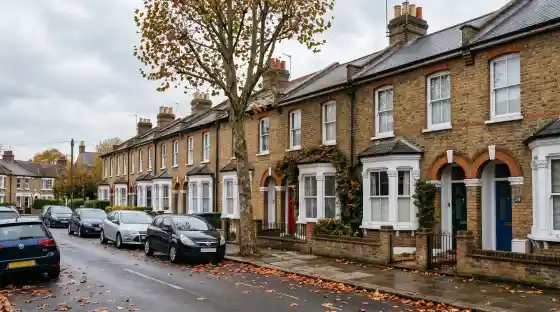
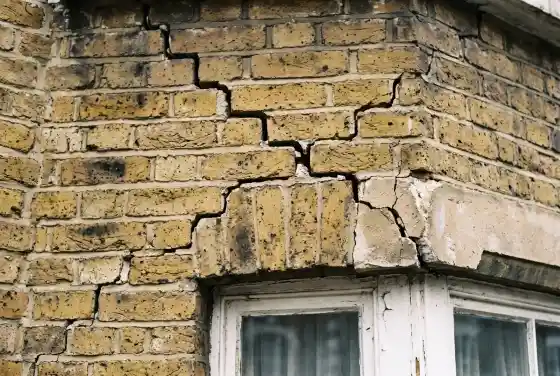
Victorian builders covered the fields of Dalston, Clapton and Stoke Newington with terraces, and the Valuation Office Agency dates 34.8% of Hackney’s homes before 1919. Those houses stand on shallow corbelled footings in clay that shrinks in dry summers and swells in wet winters, as the British Geological Survey describes, so on a Clapton or Stoke Newington terrace we look closely at bay windows and rear additions, especially near street trees. Rear walls on those Dalston terraces can be a single brick thick, and hard cement render or cement repointing over soft stock brick traps moisture until the face flakes away.
Post-war councils then replaced bomb-damaged streets with estates and towers, and a third layer has gone up since: 23.5% of Hackney homes were built in 2000 or later, against 18.5% across London. Along the Regent’s Canal, beside the Lea and at Woodberry Down, that newer stock shifts a Hackney Level 3 survey towards condensation, balcony drainage, roof terraces, cladding and the fire safety papers required under the Building Safety Act 2022.
Flats and maisonettes make up 82% of the Hackney council tax list, so even on a Victorian street in De Beauvoir the purchase is often one floor of a shared house. For a classic Clapton terrace still in single use, our period house survey covers structure, roof, damp and past alterations, and for a long-let doer-up in Homerton a renovation project survey puts the repairs in a sensible order.
Estate blocks, split houses and Hackney Wick lofts
The 2021 Census put 60.4% of Hackney households in a purpose-built block and 40.5% in social rented homes, so estate flats from Haggerston to Kings Crescent are a common first purchase. In older blocks there we look for cracked concrete, rust staining where reinforcement is corroding at balcony edges, failing flat roofs and ageing communal heating, because each can become a section 20 bill. Leasehold sales made up 82.2% of all sales HM Land Registry recorded in the borough in the year to September 2026, so lease length, ground rent and the service charge budget belong in the same conversation as the building’s condition.
Another 15.5% of households live in part of a converted house, such as the larger Victorian houses around Clapton Square and Clapton Common split into flats. Those Clapton conversions bring weak fire separation on the shared stair, sound transfer between floors and chimney breasts removed without visible support, and we look in the loft for stacks left hanging above.
Warehouse and factory conversions are a Hackney Wick speciality: 3.4% of households live in a converted former industrial or similar building, against 1.2% capital-wide. Beside the Regent’s Canal and the Lea those lofts bring large single-glazed windows, flat roofs, internal gutters and cold reveals where condensation and mould gather.
Flats over shops on Mare Street and Kingsland Road
Mare Street, Kingsland Road, Stoke Newington High Street and Lower Clapton Road are lined with Victorian shops with flats above. Typical findings on Mare Street and Kingsland Road are weak fire separation between shop and flat, takeaway extraction ducts close to windows, flat roofs over rear storerooms used as terraces, and lease repair clauses that are hard to follow. A mixed-use property survey frames those Dalston and Clapton issues for your solicitor, and a Level 3 survey in Hackney on a flat over a shop needs the shop’s rear yard and any shared roof opened on the day.
The Lea and its flood zones at Hackney Marshes
Environment Agency mapping puts 4.2% of Hackney in Flood Zone 3 and 9.7% in Zone 2 or 3, mainly along the River Lea by Hackney Marshes and Lea Bridge; the zones ignore defences, so they show exposure rather than likelihood. For a ground-floor flat or a house with a cellar near Millfields or Lea Bridge Road, check the address on the GOV.UK long term flood risk service, which also covers surface water, and expect the report to look hard at lightwells, cellar walls and signs of past water entry.
Conservation areas and Hackney’s unusual Article 4 directions
The national planning dataset counts 37 conservation areas covering 29.6% of Hackney’s land, while the council’s conservation areas page says there are now 35, the first four being Clapton Square, Clapton Common, Clapton Pond and Clissold Park in 1969. Inside De Beauvoir, Stoke Newington, Victoria Park and the rest, demolition, many external changes and tree work need consent, and listed houses on Stoke Newington Church Street need listed building consent for most alterations.
The council’s Article 4 Directions page lists non-immediate directions over the Brownswood, Beck Road and Well Street conservation areas, each in effect from May 2025, and over part of Shacklewell Green since October 2019. In Brownswood, Beck Road and Well Street, new windows, doors or front boundary works can need planning permission, so check before you budget for them. A separate direction, made in May 2017, stops 15 named launderettes, including 112 Upper Clapton Road and 202 Well Street, from changing to homes under permitted development.
Past works on a De Beauvoir or Clapton house can be traced through the council’s planning and building pages, and completion certificates for lofts, knock-throughs and removed chimney breasts come from its building control service or an approved inspector.
Prices from Clapton terraces to canal-side flats
The median price paid across Hackney was £578,250 in the year to September 2026, against £518,000 for the capital as a whole. A terraced house sold for a median £1,170,000, and a semi-detached house for £1,251,517, though that last figure rests on a small sample of sales, so treat it only as a rough guide to the few semi-detached villas in places such as De Beauvoir. On the energy register 34.3% of Hackney homes are rated D or below, lower than the capital’s 45% because of the many newer flats, while solid-walled Victorian terraces in Clapton are the likeliest to fall in that band.
Booking a Hackney survey
L3S London carries out RICS Level 3 Building Surveys on Hackney homes from Clapton terraces to Hackney Wick lofts, each inspected and signed by an RICS-qualified surveyor. Broadway Market on Saturdays and the busy stretches of Mare Street slow arrival, so weekday slots suit an E8 inspection best. To budget before you book, our guide to survey costs sets out what drives the fee for a Stoke Newington house or a Dalston flat.
What the public records say about Hackney homes
| Figure | Hackney | London | What it means for the survey | Source and period |
|---|---|---|---|---|
| Homes built before 1919 | 34.8% | 28.9% | About a third of Hackney homes predate 1919, mostly terraces on shallow corbelled footings in Dalston, Clapton and Stoke Newington. | VOA, list at 31 Mar 2026 (121,100 homes) |
| Homes built in 2000 or later | 23.5% | 18.5% | Above the capital's share, from the Regent's Canal to Woodberry Down, so warranties, cladding and fire safety papers come up often. | VOA, list at 31 Mar 2026 (121,100 homes) |
| Flats and maisonettes, share of homes | 82% | 57.5% | Most Hackney homes, from De Beauvoir to Stamford Hill, are flats, so the shared roof, walls and drains are part of every report. | VOA, list at 31 Mar 2026 (121,100 homes) |
| Households in a purpose-built block of flats | 60.4% | 40.3% | Estates and new blocks dominate; on a Kingsland or Woodberry Down block the service charge, reserve fund and plant age matter. | ONS Census 2021, 21 Mar 2021 (106,079 households) |
| Households in part of a converted or shared house | 15.5% | 11.1% | Split Victorian houses in Clapton and Stoke Newington bring fire separation, sound insulation and conversion approvals into the report. | ONS Census 2021, 21 Mar 2021 (106,079 households) |
| Households in a converted former school, church, warehouse or similar | 3.4% | 1.2% | Warehouse lofts in Hackney Wick lift this well above the capital's share, with flat roofs, internal gutters and cold bridging to check. | ONS Census 2021, 21 Mar 2021 (106,079 households) |
| Households in social rented homes | 40.5% | 23.1% | Hackney Council and housing associations own many estate blocks, so section 20 major works affect leaseholders from Haggerston to Clapton. | ONS Census 2021, 21 Mar 2021 (106,081 households) |
| Share of sales that were leasehold | 82.2% | 50.8% | Most sales in Dalston, Haggerston and Homerton are leases; lease length and service charge sit beside the building's condition. | HM Land Registry, sales Oct 2025 to Sep 2026 (1,472 sales) |
| Median price paid, all homes | £578,250 | £518,000 | Above the capital-wide median; on a Stoke Newington terrace, a hidden rear-wall or roof defect is a large cost in absolute terms. | HM Land Registry, sales Oct 2025 to Sep 2026 (1,472 sales) |
| Median price paid, terraced houses | £1,170,000 | £585,000 | A terraced house in Clapton or De Beauvoir costs over double the flat median, so structure, roofs and past alterations are the big items. | HM Land Registry, sales Oct 2025 to Sep 2026 (237 sales) |
| Median price paid, semi-detached houses | £1,251,517 | £625,000 | A small sample of sales, so treat it only as a rough guide to the few semi-detached villas in places such as De Beauvoir. | HM Land Registry, sales Oct 2025 to Sep 2026 (30 sales) |
| Homes rated D or below | 34.3% | 45% | Below the capital's share because so many homes from Woodberry Down to Haggerston are newer flats; solid-walled Victorian terraces are the likeliest to sit at D or below. | EPC register, certificates to 12 Oct 2026 (96,727 homes) |
| Share of the borough in Flood Zone 3 | 4.2% | n/a | Land beside the River Lea at Hackney Marshes and Lea Bridge (zones ignore defences); check the address and look hard at basements. | Environment Agency, published Nov 2026 |
| Share of the borough in Flood Zone 2 or 3 | 9.7% | n/a | The Lea valley edge by Millfields and Lea Bridge; lightwells, cellars and ground-floor flats there need the GOV.UK check. | Environment Agency, published Nov 2026 |
| Conservation areas (distinct names) | 37 | n/a | The dataset count; the council's page says 35, starting with Clapton Square, Clapton Common, Clapton Pond and Clissold Park in 1969. | MHCLG planning data, published Nov 2026 |
| Share of the borough inside a conservation area | 29.6% | n/a | Under a third of the borough, concentrated in Stoke Newington, De Beauvoir, Clapton and around Victoria Park. | MHCLG planning data, published Nov 2026 |
Data: Valuation Office Agency: Council Tax stock of properties 2026; ONS Census 2021; HM Land Registry Price Paid Data; Energy Performance of Buildings Register (domestic EPCs); Environment Agency Flood Map for Planning (flood zones), via planning.data.gov.uk; planning.data.gov.uk: conservation areas (MHCLG). Open Government Licence v3.0.
Questions from Hackney buyers
What should I look for in a Victorian terrace in Clapton or Stoke Newington?
Look at the rear first. On a Clapton or Stoke Newington terrace, the rear addition, its flat or shallow roof, the kitchen extension and the drains are where most problems show. Inside a Dalston or Clapton house, look for chimney breasts removed below others still in place, and for fresh plaster that may be hiding damp, which the report traces to a likely cause rather than listing symptoms.
Is Hackney a flood risk area?
Most of the borough is not, but Environment Agency maps put 4.2% of it in Flood Zone 3 and 9.7% in Zone 2 or 3, mainly along the River Lea by Hackney Marshes and Lea Bridge, and those maps ignore defences. Surface water after heavy rain can also affect basements on low streets anywhere in E5 or E9. Check the address on the GOV.UK long term flood risk service, and on a Millfields or Lea Bridge Road flat your surveyor will comment on lower ground floors, lightwell drainage and signs of past water entry.
Do Article 4 directions in Hackney affect what I can do to my house?
They can. Non-immediate directions cover the Brownswood, Beck Road and Well Street conservation areas, all in effect from May 2025, and part of Shacklewell Green, so new windows, doors or front boundary works there may need planning permission. Another direction, made in May 2017, stops 15 named launderettes, such as 202 Well Street, changing to homes without permission.
Can I get a Level 3 survey on a flat above a shop on Kingsland Road?
Yes. Flats above shops are a common purchase on Kingsland Road, Mare Street and Lower Clapton Road, and they suit the inspection because one building holds two uses. Above a Mare Street shop we inspect the flat, the visible roof and rear walls, and the separation between shop and home where it can be seen. Some lenders apply extra criteria to a Dalston or Clapton flat over a shop, so speak to your broker early.
Is a Level 3 survey useful on a new build flat in Hackney Wick?
It can be, especially once the developer's warranty years are running out or if the Hackney Wick building has had cladding or defect issues. For a flat a few years old by the Regent's Canal or the River Lea, the report looks at condensation, balcony drainage, roof terraces and communal areas, and lists the fire safety documents your solicitor should obtain under the Building Safety Act 2022.
Sources
- Hackney Council: Planning and building (checked 26 November 2026)
- Hackney Council: Building control service (checked 26 November 2026)
- Hackney Council: Conservation areas (checked 26 November 2026)
- Hackney Council: Article 4 Directions (checked 26 November 2026)
- GOV.UK: Check long term flood risk (checked 26 November 2026)
- British Geological Survey: Swelling and shrinking soils (checked 26 November 2026)
- Historic England: Search the List (checked 26 November 2026)